
Patient Education
Aging and Your Spine
At a glance
Spinal discs begin losing water and height as early as the first decade of life, and the first symptoms usually arrive as low back pain between 30 and 50. Degeneration cannot be reversed, but the stiffness, compensations and nerve irritation that come with it usually respond to conservative care. Earlier is better, because the goal is preserving motion rather than restoring it.
As we age, our bodies begin to change in ways we might not imagine until they are part of our reality. Skin, bones and muscles all experience degeneration as time goes on. It is easy to notice when skin begins to show signs of aging, but not always easy to see the changes inside until symptoms arrive: back and neck pain, stiffness, numbness. All of them are signs of an aging spine.
The wear-and-tear process starts long before any of that. Disc degeneration can begin as early as the first decade of life. It tends to be most pronounced in the lower back and neck, and the first outward sign is typically low back pain somewhere between the ages of 30 and 50.
We cannot escape the aging process. But there is a meaningful difference between a spine that ages and stiffens unchecked and one that keeps moving, and that difference is largely within your control.
What actually changes inside an aging spine
The spine is a flexible column of vertebrae separated by discs. A healthy disc has the consistency of firm gelatin, and it works as both a spacer and a shock absorber. With age, discs lose water content and height. Thinning is often accompanied by inflammation, pain and stiffness.
That loss of height has knock-on effects. As the space between two vertebrae narrows, the opening the nerve root passes through narrows with it. Where the spinal canal itself becomes narrowed, the result is spinal stenosis, which can produce low back pain, pinched nerves, and numbness or weakness in the legs. And if the softer center of a disc pushes outward, as happens with a herniated disc, it can press directly on a nerve root and turn a local ache into pain that travels down a limb.
Two other age-related conditions matter here. Arthritis typically affects the joints, and the spine has plenty of them. And osteoporosis reduces bone density over time, making vertebrae more brittle and more vulnerable to fracture. Women are more susceptible, but men lose bone density too, which is worth knowing before an avoidable fracture makes the point for you.
The three stages of spinal degeneration
Stage one. Discs begin to lose volume through fluid loss. There are usually no symptoms at all at this point, which is precisely why it goes unnoticed. It is nonetheless the stage where intervention is cheapest and most effective.
Stage two. The natural curve of the spine starts to flatten and the space once occupied by disc height narrows. Discs begin to bulge between vertebrae, bone spurs may form on the spinal joints, and joint surfaces roughen. The cumulative effect is a spine that is measurably less stable than it was.
Stage three. The curve is further reduced, disc height continues to fall, and the likelihood of herniation and bone spurs rises. Spinal stenosis may be present, and in some cases adjacent vertebrae fuse.
Stages are a useful shorthand rather than a diagnosis. Plenty of people sit at stage two with no pain whatsoever, and some at stage one are genuinely uncomfortable. What the staging is good for is explaining why the same advice does not suit everybody.
What conservative care can do about it
The honest framing is this: degeneration is not reversible, and the goal is not to reverse it. The goal is to keep the spine moving well, to stop neighboring segments compensating for the one that has changed, and to relieve the irritation that produces the actual symptoms.
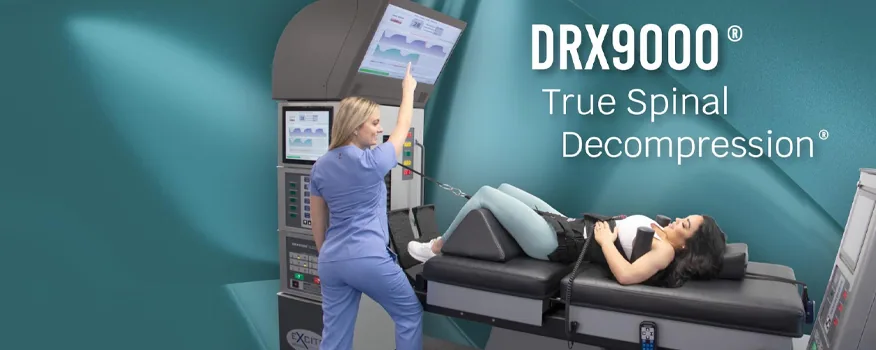
At this practice that generally means spinal adjustments to restore motion where it has been lost, traction to unload a joint or disc that is under pressure, and corrective exercise to strengthen the muscles that support the segment. Where the exam and imaging point at a disc as the pain generator, non-surgical decompression is the tool aimed at that specific mechanism, and there is a fuller explanation of how the DRX9000 table lowers pressure inside a damaged disc if that sounds like your situation. It sits alongside the rest of the equipment side of the practice, which exists precisely for the cases where hands-on care alone has stopped making a difference.
Digital X-ray on site means degenerative change can be identified before it has produced much in the way of symptoms. That is genuinely useful, with one important caveat covered below.
Why an image is not a diagnosis
Degenerative findings show up on imaging in very large numbers of people who have no pain at all. It is one of the most common traps in this field: a patient is shown a film, told their spine is degenerating, and concludes that the picture explains the pain. Often it does not.
This is why nothing here starts from an image. The examination is what connects a finding to your symptoms, and part of doing that job properly is being willing to say that the change on the film is not what is hurting you. Treating an X-ray rather than a person is how people end up on long care plans for problems they did not have.
The part that is actually within your control
Staying active is the single most useful thing you can do for an aging spine. A sedentary spine stiffens faster, and the muscles that support it weaken, which increases the load on exactly the segments already changing. Osteoarthritis in particular responds better to appropriate movement than to rest, and the National Institute on Aging’s guidance on osteoarthritis sets out what that looks like in practice.
Since degeneration starts early and is not reversible, there is no age at which it becomes too late to start, and no age at which it is too early. What changes is the objective: prevention earlier on, preservation later.
No one should have to feel that major surgery is the only answer for back pain when conservative care has not been properly tried.
Questions we get asked
At what age does spinal degeneration start?
Earlier than most people expect. Disc degeneration can begin in the first decade of life, and it is essentially universal by middle age. What varies is not whether it happens but how much it bothers you, which depends far more on how well the spine moves and how strong the surrounding muscles are than on what an X-ray looks like.
Can spinal degeneration be reversed?
No, and anyone promising otherwise is overselling. A disc that has lost height does not regain it. What can change is the pain, the stiffness and the compensations built up around the degenerated segment, and for most people that is the difference that actually matters day to day.
Does a degenerated disc on my X-ray explain my pain?
Not necessarily. Degenerative changes show up on imaging in large numbers of people with no pain at all, which is why we do not treat an image. The examination is what connects a finding to your symptoms, and sometimes the honest answer is that the change on the film is not what is hurting.
Should I still exercise with a degenerating spine?
Yes, and it is one of the more useful things you can do. A sedentary spine stiffens faster and the muscles supporting it weaken, which increases the load on exactly the segments that are already changing. The type and intensity should suit your findings, which is what the plan you leave with is for.
Is it too late to start care in my sixties or seventies?
No. The goal shifts from prevention to preserving what you have and keeping you doing the things you want to do. Plenty of people begin conservative care well into their seventies and get meaningful improvement in mobility and comfort, even though the underlying changes are permanent.