
Pain Relief
Non-Surgical Spinal Decompression in St. Augustine
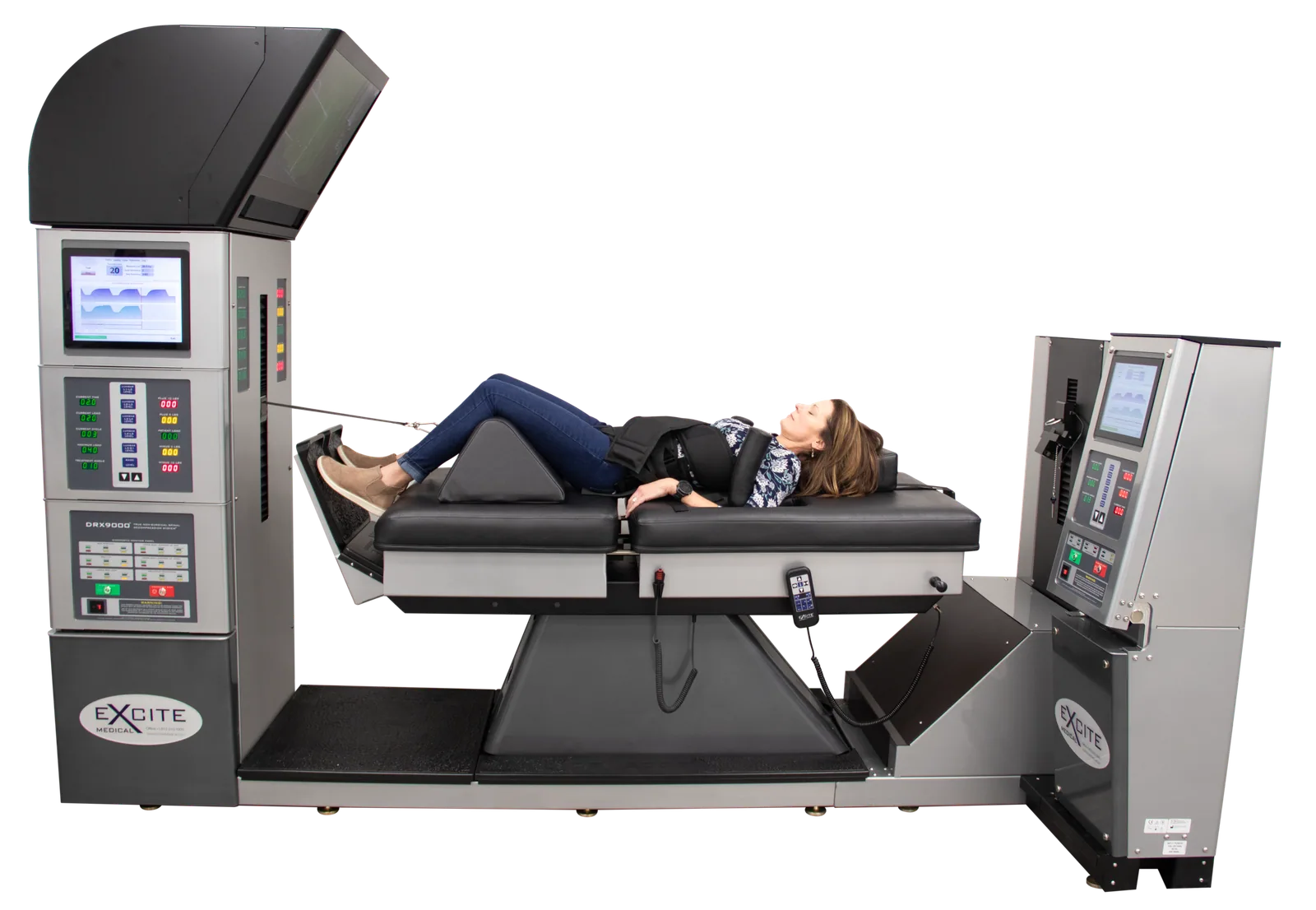
Non-surgical spinal decompression uses a motorized table to gently separate the vertebrae, easing pressure on a damaged disc and the nerve it is pressing against. At Spinal Solutions it runs on the DRX9000, and a course of care is built around what your exam and imaging actually show.
- DRX9000 on site
- 5.0 stars from 166 Google reviews
- Exam and imaging before any recommendation
What non-surgical spinal decompression actually does
A disc sits between two vertebrae and works as a shock absorber. When it bulges or herniates, it can press on the nerve root beside it, and that is when pain stops being local and starts travelling down a leg or an arm. Decompression works by separating those two vertebrae slightly and holding that separation in a controlled cycle, which lowers pressure inside the disc.
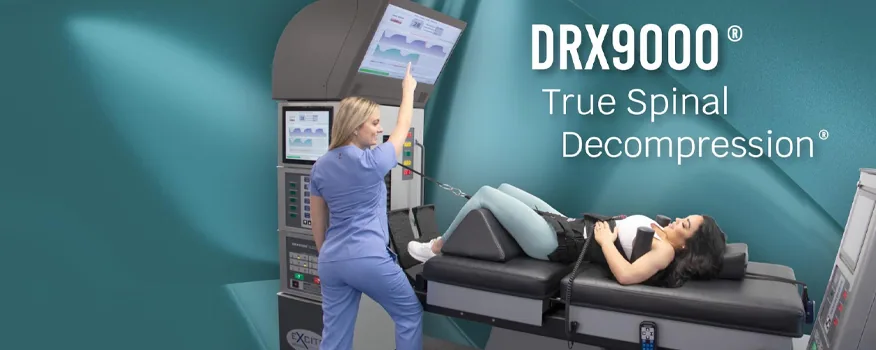
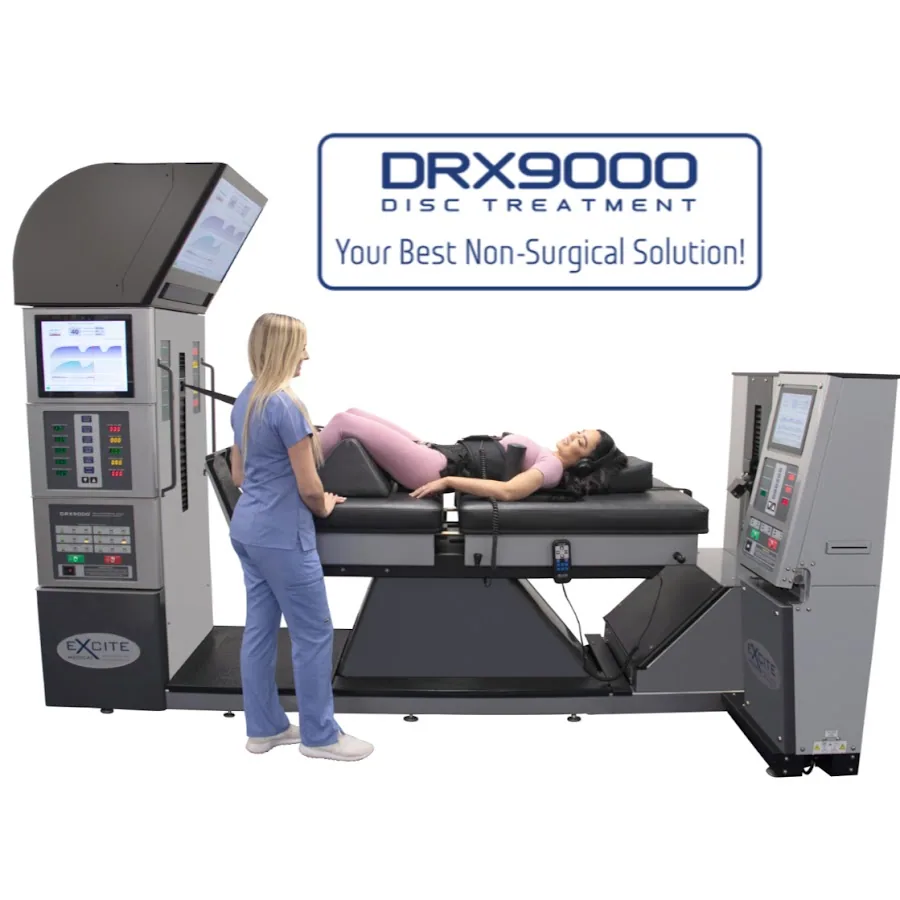
The DRX9000 is a motorized table built for exactly that job. It applies and releases traction on a programmed curve rather than a constant pull, which is what allows the surrounding muscles to stop guarding. That distinction matters, because a muscle that is bracing against traction defeats the point of the treatment.
Conservative care of this kind is the recommended starting point for most disc-related back pain, and that is worth understanding before committing to anything more invasive. There is a plain-language summary in the National Institute of Neurological Disorders and Stroke overview of low back pain.
Why it is not the first thing we reach for
Most back pain is not a disc problem. It is a joint that has stopped moving well, muscle that has taken over the work, and a movement pattern that keeps re-loading the same tissue. That responds to adjusting, soft tissue work and corrective exercise, and it costs less and takes less time.
Decompression earns its place when the exam and the imaging point at the disc, and when the simpler work has already been tried or is clearly not enough. Recommending it before that point would be selling equipment rather than treating a person.
Conditions we treat with this
- Sciatica
- Back and Hip Pain
- Neck and Shoulder Pain
- Auto Injury
- Herniated disc
- Bulging disc
- Degenerative disc disease
- Protruding disc
How it compares to the alternatives
| Option | Best for | Worth knowing |
|---|---|---|
| Non-surgical decompression (DRX9000) | Disc-related pain that has not responded to adjustments and exercise alone | Non-invasive and drug-free. Works over a course of sessions, not a single visit. |
| Chiropractic adjustment alone | Joint restriction and mechanical pain without significant disc involvement | Often the right and cheaper starting point. Decompression is added when the disc is the driver. |
| Injections | Severe inflammatory pain needing short-term control | Managed by a medical provider, not here. We refer when that is the better path. |
| Surgery | Progressive neurological deficit, or conservative care has genuinely failed | A surgical consult is the right call for red-flag findings. We will tell you when we see them. |
Who this helps, and who it does not
Usually a good fit
- Imaging or examination points to a disc as the pain generator
- Pain that radiates into the leg or arm along a nerve path
- You would rather exhaust conservative options before considering surgery
- You can commit to a course of sessions rather than one visit
Not the right treatment
- Pregnancy
- Spinal fusion hardware or certain implants
- Severe osteoporosis or an unstable fracture
- Progressive neurological loss, which needs a surgical opinion first
If this is you, we will say so and point you somewhere better.
What to expect
- 01 Examination first, always
Nothing goes on the table before an exam. We look at how you move, test the nerve, and use imaging where it is clinically warranted.
- 02 You see the findings
Dr. Sisak walks you through what is happening and why, so the decision to proceed is yours and it is informed.
- 03 On the table
You stay clothed and lie on the DRX9000 while it applies and releases traction in a controlled cycle. Most people find it comfortable enough to relax through.
- 04 The work between sessions
Decompression does not act alone. Adjustments, corrective exercise and support are layered in so the change holds.
What it costs and how payment works
New patients start with the $47 evaluation, which covers the consultation, orthopedic and neurological testing, digital imaging if it is clinically necessary, a full findings review, and a trial shockwave or red light therapy session where it is appropriate before any decompression is recommended. From there, we handle PIP and personal injury cases directly, and Medicare Part B covers manual spinal manipulation to correct a subluxation, though not exams, imaging or most therapies, so we will tell you plainly what falls outside it. We also offer in-house care plans, wellness plans and financing through CareCredit.
Why have it done here
The table is only half of it. Nate Reinhardt runs the decompression sessions, Dr. Sisak reads the exam and the imaging that decide whether you belong on it, and the adjusting and corrective work that make the change hold happen in the same building on the same plan. A clinic that owns a DRX9000 but sends you elsewhere for the rest of it is selling table time, not care.
This sits inside our wider pain relief program, so if it turns out not to be what you need, the alternative is in the same building.
Book the $47 evaluationWhat patients say
5.0 from 166 Google reviewsLast summer my back was in terrible shape after a day riding on a jet ski. I went to Dr. Derek and he provided some immediate relief but also introduced some critical stretch and strength techniques to help with injury prevention. 8 Months later I continue to visit once a month as continued preventative maintenance.
Where to find us
The clinic sits at 276 Paseo Reyes Dr in St. Augustine, Florida, just off U.S. 1 at World Golf Parkway, near the entrance to the Palencia neighborhood. Most people coming in for disc pain and decompression drive in from across St. Johns County, and the office is a straight run up or down U.S. 1 from either end of it.
- Palencia
- World Golf Village
- Nocatee
- Ponte Vedra
- Julington Creek
- Downtown St. Augustine
Questions we get asked
Does insurance pay for spinal decompression therapy?
Coverage varies by plan and by case. We handle PIP and personal injury cases directly, and Medicare Part B covers manual spinal manipulation to correct a subluxation, though not exams, imaging or most therapies. Where a plan does not cover decompression, we offer in-house care plans and financing so you can see the cost before you commit.
How much does spinal decompression normally cost?
It depends on how many sessions your findings call for, which is why we do not quote a course before the exam. New patients start with the $47 evaluation, and you get the plan and the cost in writing at the findings review, before anything begins.
Who should avoid spinal decompression?
It is not appropriate during pregnancy, with spinal fusion hardware or certain implants, with severe osteoporosis or an unstable fracture, or where there is progressive neurological loss that needs a surgical opinion first. If you fall into one of those groups we will say so and point you somewhere better.
Is spinal decompression worth the money?
It is worth it when the disc is genuinely the pain generator and conservative care alone has stalled. It is not worth it as a first move for simple mechanical pain, which usually responds to adjusting and exercise. The exam exists to tell those two situations apart.
What are the drawbacks?
It takes a course of visits rather than one, so it asks for time. Some people feel mild soreness early on as the area starts moving differently. It is also not a fit for every spine, which is why the screening comes first.
Request your appointment
Start with an exam,
not a guess.
Reading on this, from us
Written by the doctors here, on the same treatment this page describes.