
Rehabilitation
Whole Body Red Light Therapy in St. Augustine
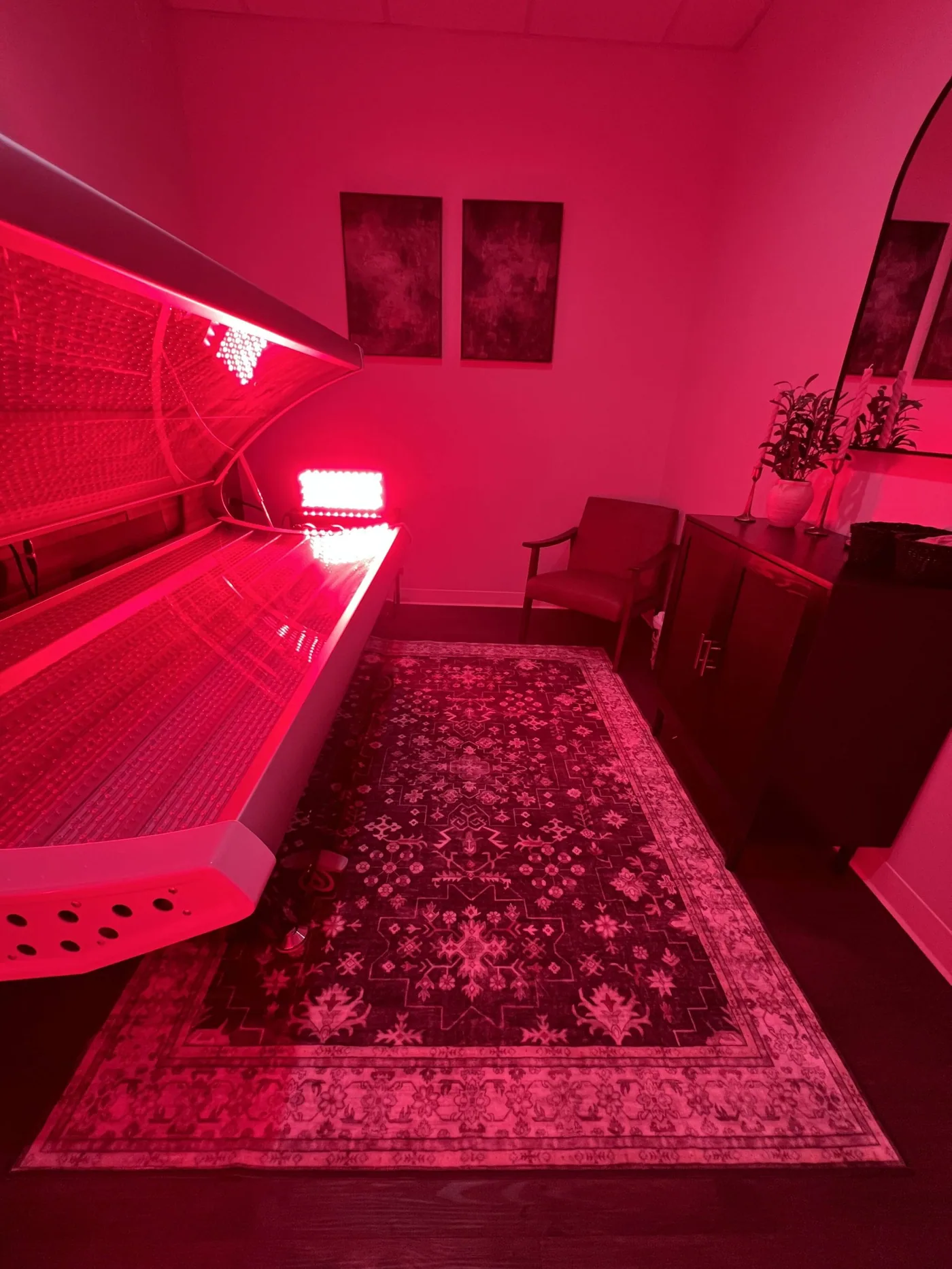
Red light therapy, also called photobiomodulation, uses specific wavelengths of red and near-infrared light to reach muscle, joint and tissue below the skin and stimulate the body's own repair processes. At Spinal Solutions it is delivered whole body on the TrifectaLight PRO 450 bed, in sessions that typically run 10 to 20 minutes with no downtime afterwards.
- TrifectaLight PRO 450 bed on site
- Sessions typically 10 to 20 minutes
- Non-invasive, drug-free, no downtime
What red light therapy is
Red light therapy, also known as photobiomodulation, uses specific wavelengths of red and near-infrared light to penetrate the skin and stimulate your body’s natural healing processes. The light energy reaches into muscles, joints and tissues, where the proposed effect is to increase cellular energy production, improve circulation, reduce inflammation, and support tissue repair.
The word “proposed” is doing real work in that sentence, and we would rather use it than skip it. The mechanisms are an active area of research rather than settled fact, and a peer-reviewed review of the proposed mechanisms of photobiomodulation sets out what is currently understood and where the uncertainty still sits. Anyone selling you certainty about this is overselling.
What we can say plainly is what it involves: a short, passive, non-invasive session with no downtime, which a lot of patients find genuinely useful as part of a recovery plan, and which some notice very little from. Results vary.
Why a whole body bed
Not all red light therapy is the same, and the difference is mostly power and coverage.
The TrifectaLight PRO 450 bed delivers full-body coverage with high-powered, medical-grade wavelengths, with even light distribution and sessions that are typically 10 to 20 minutes. This is not a handheld device or a spa-level light. It is a professional-grade system, and it is the reason a session covers everything at once rather than one joint at a time.
For someone recovering from surgery, or an athlete whose soreness is not confined to one area, that difference is the whole point.
What people come in for
Patients throughout St. Augustine use red light sessions for a range of goals:
- Pain and inflammation. Support for joint stiffness, and for chronic back and neck discomfort alongside their existing care.
- Muscle recovery. Post-training soreness and fatigue, particularly through a heavy block of work.
- Healing and rehabilitation. Support for recovery after surgery or injury, and improved circulation to an area being rehabilitated.
It also pairs well with chiropractic care, manual therapy and rehabilitation programs, which is how most people here use it: scheduled around the treatment rather than instead of it.
Being honest about the limits
Red light therapy is not a treatment for a restricted joint, a herniated disc or a torn tendon. It does not replace an adjustment, decompression, or the corrective work that makes either of those hold.
What it is, at its best, is a low-risk way to support recovery around the treatment that is actually addressing your problem. If your exam says the problem is mechanical and untreated, the honest advice is to spend your money on the mechanics first.
Conditions we treat with this
How it compares to the alternatives
| Option | Best for | Worth knowing |
|---|---|---|
| Whole body red light on a professional bed | Recovery and soreness across several areas at once | Full-body coverage in one short session. Not a handheld panel and not a spa-level device. |
| A handheld or at-home panel | One small area, treated often, at home | Convenient and far lower powered. Coverage and session time are the trade. |
| Manual therapy and adjusting | A restricted joint or tight tissue with a specific finding | This is the treatment. Red light supports recovery around it rather than replacing it. |
| Rest alone | Ordinary soreness that is already settling | Free, and frequently enough. Worth trying before paying for anything. |
Who this helps, and who it does not
Usually a good fit
- Recovering from surgery or an injury and wanting to support the healing window
- Training hard and dealing with recurring muscle soreness and fatigue
- Chronic stiffness or inflammation alongside an existing care plan
- Wanting a passive, non-invasive addition rather than another hands-on treatment
Not the right treatment
- Pregnancy, without clearance from your obstetric provider
- Taking a medication that causes photosensitivity
- An active skin cancer, or an undiagnosed lesion in the treatment area
- A diagnosed eye condition or photosensitive epilepsy, without medical clearance
If this is you, we will say so and point you somewhere better.
What to expect
- 01 A quick health screen
We review your health history, medications and any skin concerns to check red light is a good fit for you before your first session.
- 02 Into the bed
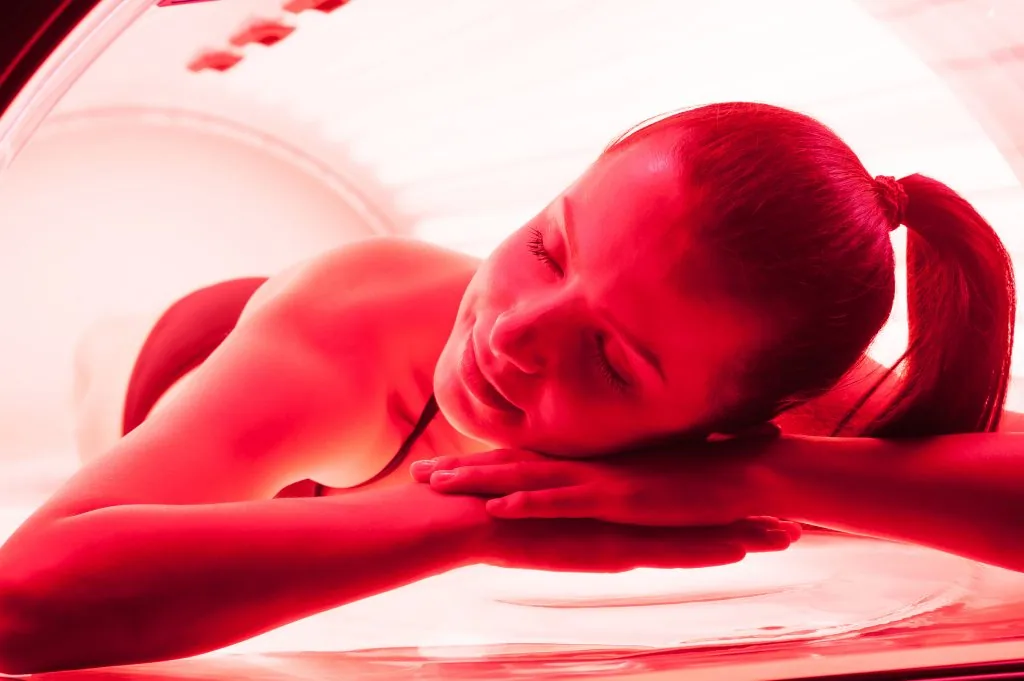
You lie comfortably in the TrifectaLight PRO 450 bed and the light surrounds your body. Eye protection is provided.
- 03 Ten to twenty minutes
Sessions typically last 10 to 20 minutes. Many patients describe it as a warm, relaxing experience, similar to resting in gentle sunlight.
- 04 Straight back to your day
There is no pain, no heat discomfort and no downtime. People commonly pair a session with an adjustment on the same visit.
What it costs and how payment works
Red light sessions are sold inside a care plan or a wellness plan rather than as a covered medical service. Medicare Part B covers manual spinal manipulation to correct a subluxation, and does not extend to red light therapy, so this is paid for directly, through an in-house plan, or with CareCredit financing. If you are new to the practice, the $47 evaluation still comes first, because we would rather know what is going on before selling you sessions. Results vary, and if red light is not likely to add much to your situation we will say so.
Why have it done here
This is a professional-grade whole body system rather than a handheld device or a spa-level light, and it sits inside a practice that is already treating you. That matters because recovery works best attached to a plan: the session is scheduled around your adjusting and your rehab, by people who know what you are recovering from.
This sits inside our recovery and rehabilitation services, so if it turns out not to be what you need, the alternative is in the same building.
Book the $47 evaluationWhat patients say
5.0 from 166 Google reviewsWe hold 166 five-star reviews across every kind of care in this practice. Rather than pick one that is not about this treatment, here is the whole profile, unedited.
Where to find us
The clinic sits at 276 Paseo Reyes Dr in St. Augustine, Florida, just off U.S. 1 at World Golf Parkway, near the entrance to the Palencia neighborhood. Most people coming in for recovery and red light sessions drive in from across St. Johns County, and the office is a straight run up or down U.S. 1 from either end of it.
- Palencia
- World Golf Village
- Nocatee
- Ponte Vedra
- Julington Creek
- Downtown St. Augustine
Questions we get asked
Is red light therapy safe?
Yes. Red light therapy is a non-invasive, drug-free treatment with no known significant side effects for most people. Our St. Augustine team will review your health history to make sure it is a good fit for you, including any medication that increases light sensitivity.
How many sessions will I need to see results?
This varies by patient and goal. Some people notice improvement in energy, soreness, or mobility after just a few sessions, while others benefit from a longer, consistent treatment plan. Results vary and we will be straight with you about what is realistic.
Can red light therapy replace chiropractic care?
No, but it pairs well as a complement to chiropractic care and manual therapy. Many of our St. Augustine patients use red light therapy alongside their regular treatment plan to support faster recovery.
Does red light therapy hurt?
Not at all. Sessions in the TrifectaLight PRO 450 bed are typically described as warm and relaxing, with no pain or heat discomfort involved.
How is this different from a tanning bed?
Completely different light. A tanning bed emits ultraviolet light, which is what tans and damages skin. Red light therapy uses red and near-infrared wavelengths, which do not tan and are not ultraviolet. The bed shape is the only thing the two have in common.
Do I have to be a chiropractic patient to use it?
You do need to be evaluated first, which for a new patient means the $47 evaluation. That is not an upsell requirement, it is so we know your history before putting you in a device, and so we can tell you honestly whether it is worth your money.
Request your appointment
Start with an exam,
not a guess.
Reading on this, from us
Written by the doctors here, on the same treatment this page describes.
How Red Light Therapy Actually Works
Photobiomodulation is the real name for red light therapy, and the mechanism behind it centers on mitochondria. Here is the honest version of how it works.
Read the articleSeptember 3, 2026Red Light Therapy and Skin: What the Research Shows
Collagen, fibroblasts, and what the research actually says about red light and skin, from a clinic that is not selling a cosmetic result.
Read the articleSeptember 3, 2026Using Red Light Therapy for Recovery
Muscle soreness, post-surgical recovery, chronic stiffness: here is what the research says about red light's role in each, and why it is not used alone.
Read the article