
Patient Education
7 Conditions Shockwave Therapy Can Help With
At a glance
Shockwave therapy is generally considered for tendon and soft tissue conditions that have stalled past normal healing, including plantar fasciitis, tennis and golfer's elbow, rotator cuff and shoulder tendinopathy, hip bursitis, patellar tendinitis, stubborn muscle knots, and TMJ-related jaw tension. Each of these needs an exam first, since the same symptom can have more than one cause. Results vary, and this is a summary, not a diagnosis.
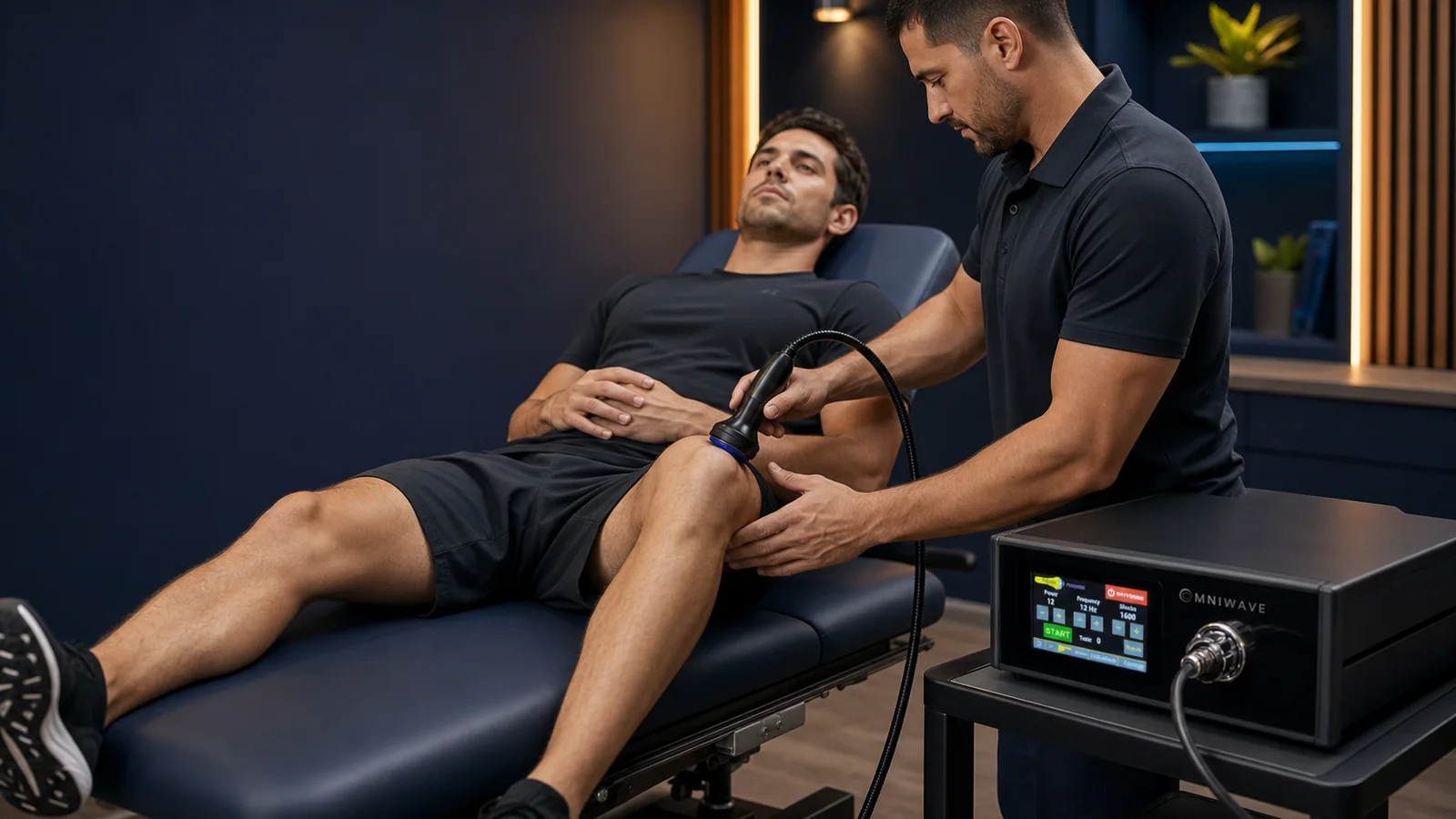
The conditions below are not a diagnosis, and reading this list is not a substitute for an exam. What they have in common is a pattern this practice sees often: tendon or soft tissue pain that has been present for months, in a specific and identifiable spot, that has stopped responding to rest or hands-on care alone. Here is generally where that pattern shows up, and why.
Plantar fasciitis and heel pain
Heel pain that is worst with the first steps of the day is the classic sign of plantar fasciitis, caused by small tears and irritation in the band of tissue running along the bottom of the foot. AAOS’s overview of plantar fasciitis and heel spurs notes that the heel spurs often seen on an X-ray in these cases are usually not the actual source of pain, which is a useful thing to know before assuming a bone spur is what needs fixing. Shockwave is considered here when the fascia itself has been irritated for months rather than weeks.
Tennis elbow and golfer’s elbow
Pain on the outside of the elbow, worse with gripping, is usually tennis elbow. The mirror-image version on the inside of the elbow, more common in golfers and throwers, is golfer’s elbow. AAOS’s patient guide to tennis elbow describes both as overuse injuries to the tendons attaching forearm muscles to the elbow, worn down faster than they can repair from repeated gripping and twisting motions. Both versions are considered candidates for shockwave once conservative care alone has plateaued.
Shoulder tendinopathy and rotator cuff pain
Pain with overhead reaching, or that wakes you up when lying on that side, often points to the rotator cuff, a group of tendons that can become irritated from years of overhead work or sport. AAOS’s guide to rotator cuff tears and shoulder pain distinguishes a degenerative, overuse-driven tendinopathy from an acute tear, and that distinction matters: shockwave is aimed at the former, not a tendon that has actually torn.
Hip bursitis and gluteal tendon pain
Pain on the side of the hip, worse on stairs or lying on that side at night, is often bursitis or irritation of the gluteal tendons at the point of the hip. AAOS’s patient guide to hip bursitis describes it as more common with repetitive stress from walking, running or standing for long periods, and notes it affects women and middle-aged adults more often. It is a common candidate once rest and stretching have stopped helping.
Patellar tendinitis and knee pain
Pain just below the kneecap, often called jumper’s knee, comes from repeated strain on the tendon connecting the kneecap to the shinbone. A clinical overview of patellar tendinopathy, or jumper’s knee notes it is especially common in sports involving running and jumping, where the tendon is loaded repeatedly under high force. It is a straightforward candidate for shockwave once the acute phase has passed, though a knee that is swollen, unstable, or recently and acutely injured needs to be evaluated for a possible tear before anything else is tried, which is exactly the kind of distinction the exam exists to make.
Trigger points and TMJ-related jaw tension
Chronic muscle knots, or trigger points, are tight bands of tissue that can refer pain to other areas of the body, which sometimes makes them harder to pin down than a simple local ache. Jaw tension is a related but distinct issue: NIDCR’s overview of temporomandibular disorders describes myofascial pain in the muscles that control jaw movement as one of the main categories of TMJ dysfunction, alongside joint and arthritic causes, and notes it affects roughly 5 to 10 percent of the U.S. population.
Shockwave applied to the muscles around the jaw is considered for the myofascial version specifically, not for a structural joint problem, which is another reason a proper look at the shockwave service and who it fits matters before assuming it applies to your case.
The exam decides, not the list
Reading a description here that sounds like your pain is a reasonable reason to ask about shockwave. It is not a reason to assume it is already the answer. Two people with what sounds like the same condition can have different tissue involved, different severity, and different histories, and that is exactly what an exam is for. This list, and the rest of the pain-relief options here, exist because tendon and soft tissue pain rarely resolves the same way twice.
Questions we get asked
Does having one of these conditions guarantee I am a candidate for shockwave?
No. This list describes conditions where shockwave is commonly considered, not a guarantee that it is the right treatment for your specific case. Two people with plantar fasciitis can need different plans depending on how long they have had it and what else the exam finds.
What if my pain does not match any of these seven conditions?
Shockwave is used for a range of tendon and soft tissue problems beyond this list, and plenty of pain does not fit neatly into any single named condition. The exam is what identifies what is actually generating your symptoms, which matters more than matching a label.
Why do plantar fasciitis and jaw tension both show up on this list?
Because the common thread is tissue, not location. Plantar fasciitis, tennis elbow and jaw tension all involve soft tissue that has become irritated or overloaded in a specific spot, which is the kind of problem shockwave targets, regardless of where in the body it happens to be.
Is trigger point pain the same as a pinched nerve?
No, and telling the two apart matters. A trigger point is a tight band of muscle that can refer pain elsewhere without involving a nerve directly. A pinched nerve usually produces pain that travels in a specific pattern, often with numbness or weakness, and it calls for a different approach.
How does shockwave help with TMJ symptoms specifically?
It is aimed at the muscle tension around the jaw rather than the joint structure itself. For people whose TMJ symptoms come from clenching or chronically tight jaw and neck muscles, that distinction matters, and the exam is what determines whether that is actually the driver in your case.